
The Last Frontier
The Big Horn Basin of northern Wyoming was among the last areas of the American frontier to be settled. From 1847 to 1900, the Church of Jesus Christ of Latter-day Saints established hundreds of settlements throughout Utah and the Intermountain West. The colonization of the Big Horn Basin would become one of their final — and most ambitious — projects.
The Colonization Company
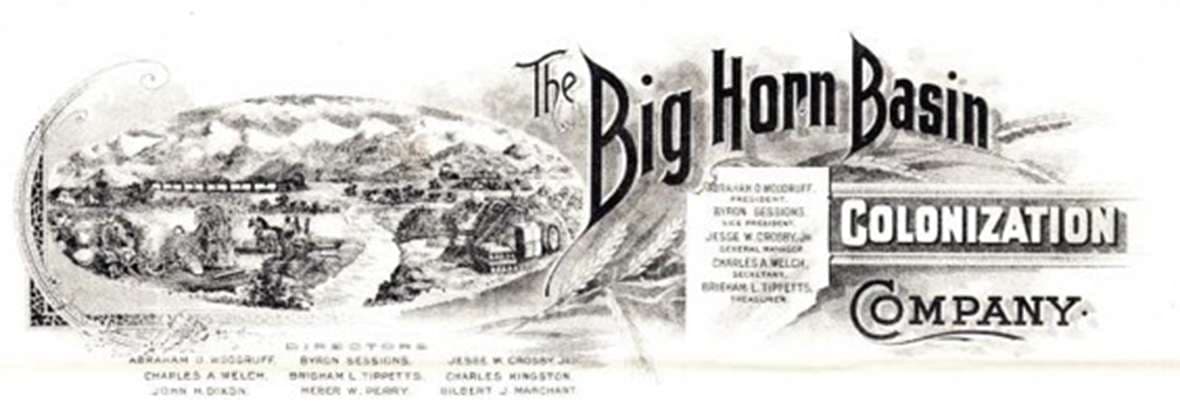
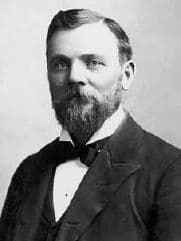
On April 9, 1900, the Big Horn Basin Colonization Company was organized with a singular purpose: build an irrigation canal north of the Shoshone River and establish agriculture and communities in the Basin. The effort was led by LDS Church Apostle Abraham Owen Woodruff, along with Byron Sessions, Jesse W. Crosby, and Charles A. Welch — the three men who would become the top ecclesiastical leaders for all Mormons in the Big Horn Basin.
In February 1900, a group of explorers were sent to find a suitable location for a colony in Northern Wyoming. The group met with William F. “Buffalo Bill” Cody, who relinquished water rights from the Shoshone River to the colonists. The town they founded was named in honor of Matthias F. Cowley (1858–1940), one of the Apostles of the Church at the time.
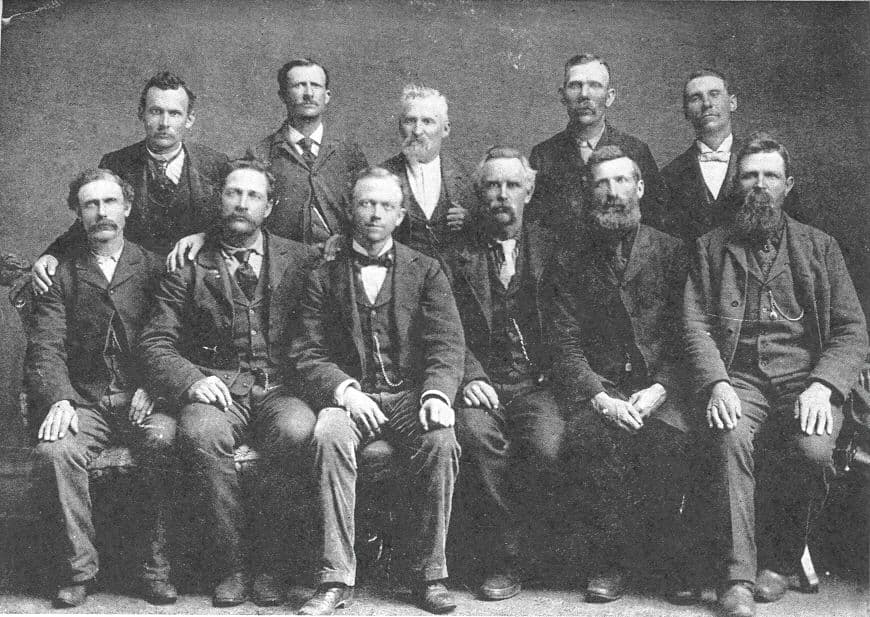
Settlers were drawn by reports of cheap land and reliable water from the Shoshone River (then called Stinking Water until the Wyoming Legislature renamed it in 1901). The Church-run Deseret Evening Newspublished articles promoting the colonization, but the most effective recruitment was personal communication — word of mouth from family and friends already in the Basin. Nearly all settlers who came had extended family members who also immigrated, with migration peaking between 1900 and 1905.
Arrival & Hardship
The first settlers arrived in May 1900. Construction of the irrigation canal became the immediate priority, delaying home building. Conditions were harsh.
“No houses had been built … some had tents, others sheep wagons …”
Settler Eliza Black remembered: “Tents were lined up and down along the river.” The constant wind created pervasive sand infiltration. She wrote to her mother: “My clock won't run anymore it is so full of sand.”
The Sidon Canal
The canal that would make settlement possible stretched 37 miles from the Shoshone River to the farms near Byron and Cowley. It would not be completed until 1904 — four years of grueling labor.
“Day after day, week after week, and month after month it was ditch, ditch, ditch, and it took grit to keep it up.”
Over a century later, the Sidon Canal continues to operate, bringing water to the farms and communities it was built to serve.
Survival & the Railroad
In the fall of 1900, I. S. P. Weeks of the Chicago, Burlington and Quincy Railroad offered the Mormon settlers a construction contract for a Montana-to-Cody railroad line. The settlers viewed this as “divine intervention” — they desperately needed cash for supplies.
Jesse W. Crosby directed railroad construction with one group of settlers, while Byron Sessions led canal work with the rest. Railroad workers split their wages with the canal workers, and canal workers split their canal stock payments with the railroad workers. Over subsequent years, the settlers undertook contracts for additional canals, roads, other railroad lines, and the Dome Lake Reservoir in the Bighorn Mountains.
Establishing the Town
In September 1900, the town sites of Byron and Cowley — approximately seven miles apart — were officially laid out. Settlers drew lots for property, many receiving land they had never seen. Charles Welch noted: “Men could be seen going in all directions to find out where their homes were to be found.”
Work on the canal was suspended while settlers constructed homes for winter. By winter 1900, there were approximately 18 log houses built in the area, by families including Baird, Black, Burke, Cook, Dickson, Fraser, Graham, Lewis, Marchant, Nebeker, Partridge, Simmons, Taggart, Tucker, Turnbow, Willis, and Harston.
Education
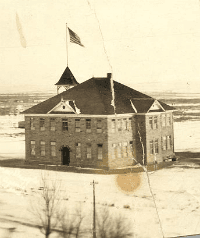
The first school was opened in a log house in January 1901, with Eliza R. Black as the first teacher and about 24–30 students. On September 26, 1910, the Big Horn Academy was opened in Cowley as the first high school. The first graduating class was the class of 1912, consisting of 13 students.
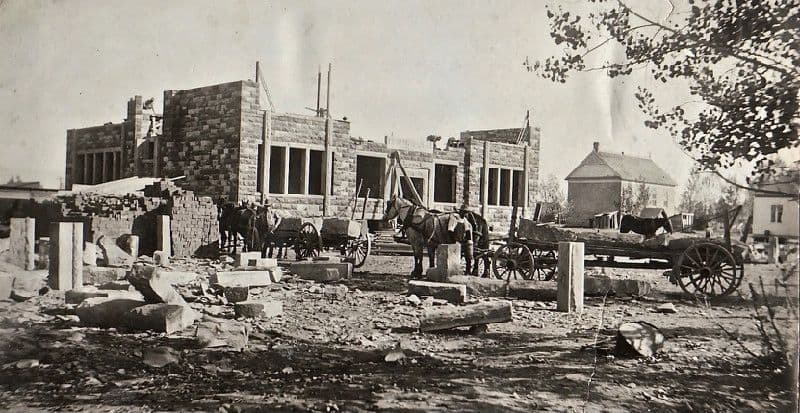
A new stone building was erected to house the Big Horn Academy in 1916. In 1925, the name was changed to Cowley High School, and the school's mascot was the Jaguars. Due to declining enrollment, the school in Cowley was closed in 1983. Beginning in 1984, the town's students attended the consolidated Rocky Mountain High School in Byron, Wyoming. For the 2010–2011 school year, Rocky Mountain High School moved to Cowley with the completion of a new building.
Community Life
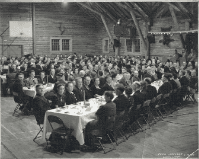
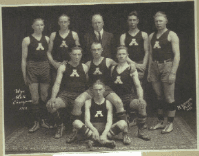
The Mormons brought what one historian described as “a new kind of social and political stability” to what had been a rough, lawless region. Cowley quickly developed a strong sense of community, with sports, gatherings, and civic life at its center.
Cowley Today
Cowley sits approximately 25 miles north of Lovell in Big Horn County, northwestern Wyoming. The community covers roughly half a square mile and occupies a charming spot nestled between the Bighorn Mountains to the west and expansive plains to the east, near the Shoshone River and Bighorn Canyon.
The town offers residents a strong sense of community and a welcoming atmosphere with amenities including a local school, outdoor swimming pool, parks, and a top-flight lighted baseball field. Outdoor recreation opportunities abound, including hiking, fishing, hunting, and winter sports.
Historical information sourced from With Book and Plow by Mark N. Partridge (2003, Family History Publishers) and “Mormon Colonizers in Wyoming's Bighorn Basin” on WyoHistory.org.